
Large language models are impressive, but they lie. Not out of malice, but because they predict the next likely word rather than checking facts. This tendency to generate plausible-sounding nonsense-known as hallucination is the generation of factually incorrect or nonsensical information by an AI model-is the biggest barrier to trusting AI in high-stakes fields like healthcare and finance. If you’ve ever asked a chatbot for medical advice and received a confident but wrong answer, you’ve seen this problem firsthand.
The industry’s leading solution to this crisis is Retrieval-Augmented Generation, also known as RAG. It is an architectural pattern that combines large language models with external knowledge bases to ground responses in real data. Instead of relying solely on its pre-trained memory, a RAG system fetches relevant documents from a trusted source before generating an answer. The result? A dramatic drop in errors. But how much does it actually help? And what are the limits?
Why LLMs Hallucinate Without External Data
To understand why RAG works, we first need to look at why standard Large Language Models (LLMs) like GPT-3.5 or GPT-4 fail. These models are trained on massive datasets scraped from the internet up to a specific cutoff date. They learn patterns, not facts. When you ask a question, the model calculates which words statistically follow your prompt. It doesn’t “know” if the capital of Peru is Lima; it knows that “Lima” often follows “capital of Peru” in text.
This creates two major risks:
- Outdated Information: If the world changes after the training cutoff, the model stays stuck in the past.
- Confabulation: If the model isn’t sure, it fills the gap with probable-sounding text rather than saying “I don’t know.”
In a 2024 study published in JMIR Cancer, researchers Nishisako et al. found that without external grounding, even advanced models like GPT-4 had a 6% hallucination rate when answering general cancer-related questions using only broad search results. For critical domains where accuracy is non-negotiable, a 1-in-17 error rate is unacceptable.
How RAG Architecture Grounds Responses in Reality
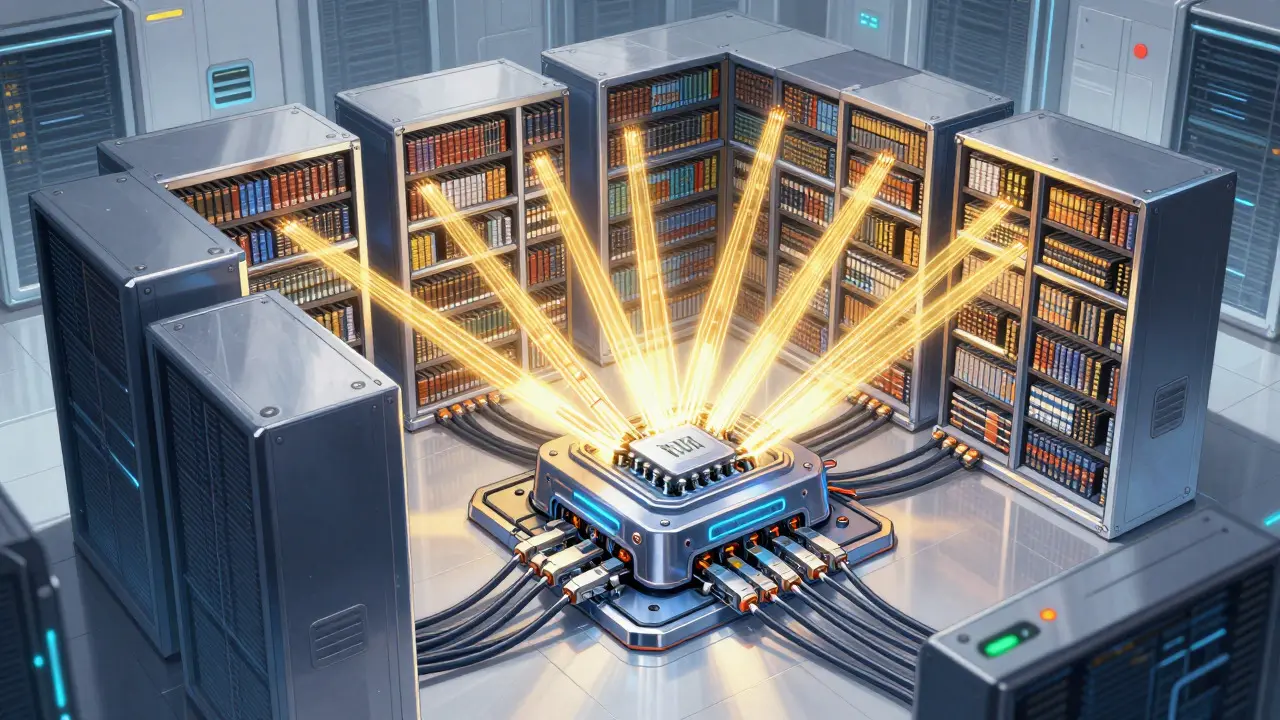
RAG solves this by adding a retrieval step between the user’s query and the model’s response. Think of it like taking an open-book exam instead of a closed-book one. The architecture consists of two main parts:
- The Retriever: This module takes your question and searches a vector database for relevant documents. It uses semantic search (understanding meaning) rather than just keyword matching. According to AWS technical documentation from February 2024, a well-tuned retriever can achieve approximately 85% precision in finding relevant chunks.
- The Generator: This is the LLM itself. It receives both your original question and the retrieved documents. It then synthesizes an answer based strictly on that provided context.
The magic happens in the constraint. By forcing the model to use only the retrieved text, you limit its ability to invent facts. In the same JMIR Cancer study, when GPT-4 was paired with RAG using curated Cancer Information Service (CIS) sources, the hallucination rate dropped to 0%. That’s not a small improvement; it’s a complete elimination of factual errors in that specific test set.
| Model Configuration | Source Type | Hallucination Rate |
|---|---|---|
| GPT-3.5 (Baseline) | General Internet Search | 10% |
| GPT-3.5 + RAG | Cancer Information Service (CIS) | 6% |
| GPT-4 (Baseline) | General Internet Search | 6% |
| GPT-4 + RAG | Cancer Information Service (CIS) | 0% |
Note that GPT-3.5 still showed a 6% error rate even with RAG. This highlights a crucial point: RAG reduces hallucinations, but it doesn’t eliminate them entirely unless the base model is strong enough to follow instructions precisely.
Measuring the Impact: Metrics That Matter
You can’t improve what you don’t measure. To truly assess RAG’s impact, you need specific metrics. Industry leaders like Amazon Web Services recommend using frameworks like RAGAS (Retrieval-Augmented Generation Assessment) to evaluate performance. Two key metrics stand out:
- Answer Correctness: Does the final output match the ground truth? This is the ultimate goal.
- Answer Relevancy: Is the answer directly addressing the user’s prompt without unnecessary fluff?
In enterprise implementations, such as those reported by AWS customers using Amazon Bedrock Agents in early 2024, these metrics helped identify a 60-75% reduction in hallucination rates across customer service applications. However, achieving this required significant tuning. One healthcare startup engineer noted on Reddit in August 2024 that their team spent weeks optimizing document chunking and metadata tagging to get their hallucination rate down from 12% to 0.8%.
Another emerging tool is ReDeEP, a 2024 research framework that traces hallucinations by identifying exactly when generated content deviates from retrieved passages. This allows developers to pinpoint whether the error came from bad retrieval or poor synthesis.
Where RAG Fails: The Remaining Risks
Despite the success stories, RAG is not a silver bullet. Mindee’s technical analysis from June 2024 identified three persistent failure modes:
- Retrieval Issues: The retriever might find documents that are topically relevant but factually wrong. If your knowledge base contains outdated or incorrect information, the RAG system will confidently repeat those errors. In poorly tuned systems, this error rate can be 15-20%.
- Fusion Problems: When multiple documents contradict each other, the LLM might struggle to synthesize a coherent answer, leading to confusion or invented compromises.
- Confidence Misalignment: The model might express high confidence in an answer derived from weak or irrelevant retrieved snippets.
For example, K2view’s September 2024 report noted that RAG systems still produce hallucinations at 5-15% rates when relying solely on unstructured internal data without structured data integration. If you’re building a system for creative writing, RAG might actually hinder performance by restricting the model’s imagination. But for factual queries, these limitations are manageable with proper engineering.
RAG vs. Fine-Tuning: Which Is Better for Accuracy?
Many teams consider fine-tuning their LLMs to reduce hallucinations. While fine-tuning adapts the model’s weights to a specific domain, it requires extensive computational resources-typically 40-100 hours for domain-specific adaptation. More importantly, fine-tuning doesn’t solve the problem of outdated information. Once the model is trained, its knowledge is static.
RAG, on the other hand, provides real-time access to updated information without retraining. You can swap out your knowledge base overnight, and the model reflects those changes immediately. According to Zero Gravity Marketing’s comparative analysis, RAG is superior for tasks requiring factual accuracy and up-to-date data. Fine-tuning remains better for stylistic adjustments or deep domain expertise where reference materials are scarce.
However, hybrid approaches are gaining traction. Some enterprises use fine-tuning to teach the model how to follow instructions better, while using RAG to provide the actual facts. This combination leverages the strengths of both methods.

Implementation Challenges and Best Practices
Getting RAG right is harder than it looks. AWS estimates that successful enterprise implementation takes 3-6 weeks, with 20-40 hours dedicated just to tuning the retriever-generator handoff. Here are some practical tips based on real-world deployments:
- Curate Your Sources: As shown in the JMIR Cancer study, source quality is everything. Using curated, verified documents (like CIS materials) yielded 0% hallucinations, while general Google search results led to 6% errors. Garbage in, garbage out.
- Optimize Chunking: How you split your documents matters. Too large, and the model gets distracted by irrelevant info. Too small, and context is lost. Experiment with different chunk sizes and overlap settings.
- Use Metadata Filtering: Tag your documents with metadata (e.g., date, author, department) to ensure the retriever fetches the most relevant and recent information.
- Set Human-in-the-Loop Thresholds: Use RAGAS scores to trigger human review when confidence drops below a certain level. Amazon’s Bedrock documentation suggests establishing custom thresholds for “answer correctness” to catch potential failures before they reach users.
Documentation quality varies across frameworks. LangChain, a popular open-source framework, has over 350 open issues related to hallucination persistence on GitHub as of October 2024, with common complaints about incorrect fusion of multiple documents. Specialized solutions like Mindee’s offer smaller communities but faster support for critical issues.
The Future of Hallucination Reduction
The landscape is evolving rapidly. Gartner projected that 70% of enterprise AI applications would incorporate RAG by 2025, up from 35% in 2023. Regulatory bodies are also catching up. The FDA’s April 2024 guidance on AI in healthcare specifically endorsed retrieval-augmented approaches for patient-facing applications, recognizing their ability to ground responses in verified literature.
Future developments include multimodal retrieval (combining text, images, and audio) and self-correcting RAG systems that iteratively validate outputs against sources. Preliminary tests suggest that integrating structured data with unstructured RAG could reduce remaining hallucinations by an additional 15-25%.
While no system is perfect, RAG currently offers the most effective path to reliable AI. By measuring impact rigorously and addressing its limitations, organizations can build systems that users trust.
Does RAG completely eliminate hallucinations in LLMs?
No, RAG significantly reduces hallucinations but does not eliminate them entirely. In optimal conditions with high-quality sources and advanced models like GPT-4, hallucination rates can drop to 0%, as seen in specific healthcare studies. However, in broader applications with imperfect data or weaker models, residual errors of 5-15% may persist due to retrieval issues or synthesis problems.
How long does it take to implement RAG for hallucination reduction?
Enterprise implementation typically takes 3-6 weeks. This includes setting up vector databases, integrating embedding models, and tuning the retriever-generator handoff. Initial configuration alone can require 80-120 hours, depending on the complexity of the data and the desired accuracy thresholds.
What are the best metrics for measuring RAG performance?
The most effective metrics are “answer correctness” and “answer relevancy,” often evaluated using frameworks like RAGAS. Answer correctness measures if the output matches ground truth, while answer relevancy ensures the response directly addresses the prompt without unnecessary information.
Is RAG better than fine-tuning for reducing hallucinations?
For factual accuracy and up-to-date information, yes. RAG allows real-time updates without retraining, whereas fine-tuning locks knowledge into the model at a specific point in time. Fine-tuning is better for stylistic consistency or deep domain expertise where reference materials are limited.
What causes hallucinations in RAG systems despite external data?
Three main causes: 1) Retrieval issues, where the system fetches topically relevant but factually incorrect documents; 2) Fusion problems, where the model incorrectly synthesizes conflicting information from multiple sources; and 3) Confidence misalignment, where the model expresses high certainty in weakly supported answers.