
You are staring at a blank screen, trying to decide where your next big AI feature will live. Do you call the cloud, or do you build the server room? It is not just a tech choice; it is a bet on how fast your users need answers and how much you trust your data to travel over the internet.
The debate between API-based LLM services and on-premises deployment has moved past simple cost comparisons. In 2026, with models like DeepSeek R1 and Llama 4 closing the gap with proprietary giants, the decision hinges on two hard metrics: latency and control. If you get these wrong, you either pay for speed you do not need or suffer delays that kill user engagement.
Quick Summary / Key Takeaways
- Cloud APIs offer near-infinite scalability and zero maintenance but add 1.4-1.8 seconds of network latency per request.
- On-prem systems deliver sub-second responses and total data sovereignty but require dedicated hardware and specialized MLOps staff.
- For high-volume workloads (over 2 million tokens daily), local deployment often becomes cheaper than paying per-token API fees.
- Hybrid architectures are the emerging standard: keep sensitive or real-time data local, send bursty or exploratory tasks to the cloud.
- Regulated industries (banking, healthcare) almost always favor on-prem for compliance, while startups prefer cloud for speed-to-market.
Latency: The Hidden Cost of Cloud Speed
When people think about cloud computing, they imagine infinite power. They forget the wire. Every time your app sends a prompt to an external provider, that data leaves your building, travels through fiber optics, hits a remote GPU cluster, processes, and comes back. This round-trip is not free.
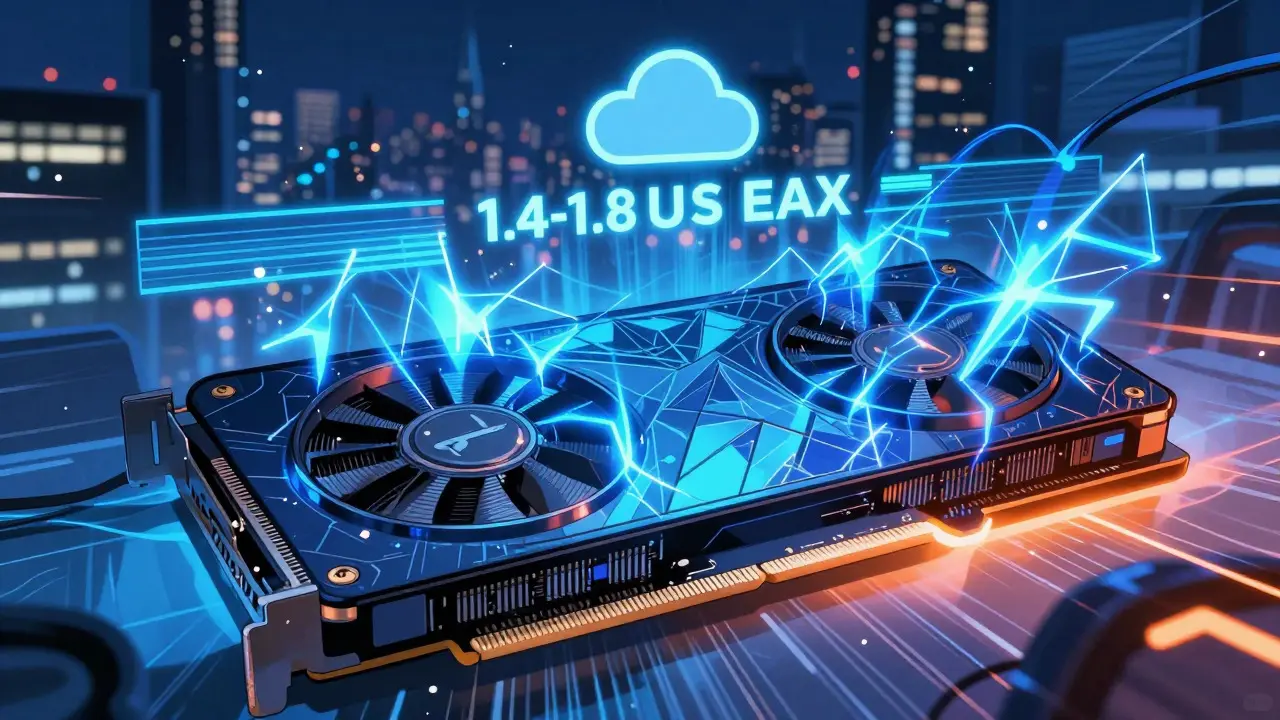
Average cloud LLM inference latency sits between 1.4 and 1.8 seconds per request. For a chatbot, that is acceptable. For a real-time trading bot or a robotic arm adjusting in a factory, that delay is fatal. On-premises infrastructure eliminates the network hop entirely. With modern hardware like the RTX 5090, which boasts 1.79TB/s bandwidth, local setups can generate 50 to 100 tokens per second consistently. There is no congestion, no geographic routing, no vendor throttling during peak hours.
However, do not assume local is always faster in raw compute. Cloud providers operate massive clusters of state-of-the-art GPUs. For complex reasoning tasks that take minutes anyway, the slight network overhead is negligible. The advantage of on-prem is consistency. You know exactly what your machine can do because it is yours. Cloud performance varies based on their load balancing and your region's connectivity.
Control and Data Sovereignty: Who Owns Your Output?
This is where the conversation shifts from physics to politics. When you use an API, your data leaves your jurisdiction. Even if the provider promises "zero retention," you are trusting a third party with your intellectual property. For banks, hospitals, and government agencies, this is a non-starter. Regulatory bodies often require that patient records or financial ledgers never leave the country, or even the building.
On-premises deployment gives you total control. You can fine-tune models on proprietary data without worrying about leakage into a shared training set. You can patch security vulnerabilities immediately without waiting for a vendor release cycle. But this freedom comes with a price tag: responsibility. If the server crashes at 3 AM, there is no support ticket. It is your problem.
API services, conversely, offer limited customization. You tweak temperature parameters or system prompts, but you cannot change the underlying model weights unless the vendor allows it. This creates vendor lock-in. Switching from one API provider to another means rewriting integration code and re-testing edge cases. On-prem, you own the asset. Migration is harder technically, but you are not dependent on a single company's roadmap.
Scalability: Elasticity vs. Rigidity
Imagine your product launches and traffic spikes 10x overnight. How do you handle it?
- Cloud Scenario: You scale up automatically. Within minutes, new GPU instances spin up. You pay more, but you stay online.
- On-Prem Scenario: You check your inventory. You realize you need four more servers. You place the order. Procurement takes two weeks. Setup takes three days. By then, your users have left.
This elasticity is the killer feature of cloud deployment. It is perfect for startups, pilots, and seasonal businesses. On-prem scaling is rigid. You must predict demand months in advance. If you over-provision, you waste money on idle hardware. If you under-provision, you bottleneck. However, for steady-state workloads where usage is predictable, the rigidity of on-prem is actually a feature. You buy once, amortize over five years, and stop paying variable fees.
Cost Analysis: The Math Behind the Decision
Let’s look at the numbers, because "cheap" is relative.
| Factor | API-Based LLM | On-Premises LLM |
|---|---|---|
| Upfront Cost | Near Zero | High (Hardware + Setup) |
| Ongoing Cost | Per-Token Fees | Electricity + Cooling + Staff |
| Hidden Costs | Prompt Caching (20-40% of opex), Rate Limits | MLOps Engineer ($135k/yr), Compliance Overhead (5-15%) |
| Break-even Point | Low Volume / Variable Usage | >2 Million Tokens Daily |
| Depreciation | None (OpEx) | Yes (CapEx, Amortizable) |
If you process fewer than 2 million tokens a day, the API is likely cheaper. Why? Because you avoid hiring a $135,000/year MLOps engineer and buying cooling systems that add 15-30% to your electricity bill. But if you are processing millions of tokens daily, the per-token fees add up fast. At that volume, owning the hardware becomes the smarter financial play. You capitalize the expense, depreciate it, and enjoy lower marginal costs per token.
Choosing the Right Path: A Decision Framework
There is no universal winner. The right choice depends on your specific constraints. Here is how to decide:
- Choose Cloud API if:
- You are a startup or SaaS company needing rapid time-to-market.
- Your workload is bursty or unpredictable.
- Data sensitivity is low (e.g., public content generation).
- You lack in-house ML infrastructure expertise.
- Choose On-Prem if:
- Regulatory compliance requires data localization (Banking, Healthcare).
- You need sub-second latency for real-time applications.
- You process high volumes (>2M tokens/day) consistently.
- You need deep, domain-specific fine-tuning.
Many sophisticated enterprises now adopt a hybrid approach. They run their core, sensitive, high-volume workloads on-prem to save money and ensure speed. They use cloud APIs for experimental projects, seasonal spikes, or when they need access to the absolute latest frontier models before they are available locally. This balances risk, cost, and capability.
Frequently Asked Questions
Is on-prem LLM deployment always slower than cloud?
No. On-prem is typically faster for initial token generation and overall response time because it removes network latency. However, cloud providers may have more powerful aggregate hardware for very long-context tasks. For most enterprise use cases, on-prem offers superior consistency and lower end-to-end latency.
What is the break-even point for switching from API to on-prem?
A common rule of thumb is around 2 million tokens processed daily. Below this threshold, the fixed costs of hardware and staffing usually outweigh the savings on API fees. Above this threshold, the variable cost of API calls becomes prohibitive, making capital expenditure on local hardware more economical.
Can I mix API and on-prem models in one application?
Yes, this is known as a hybrid architecture. You can route sensitive or latency-critical queries to your local model and send general-purpose or bursty queries to a cloud API. This requires a routing layer but offers the best balance of cost, speed, and control.
How much does it cost to maintain on-prem LLM infrastructure?
Beyond hardware, expect to budget for electricity ($0.10-$0.30/kWh), cooling (15-30% overhead), and specialized MLOps engineering staff (averaging $135,000 per year). Compliance overhead in regulated industries can add another 5-15% to operational costs.
Do open-source models perform as well as closed-source APIs?
As of 2026, the gap has largely closed for many tasks. Models like DeepSeek R1, Qwen 3, and Llama 4 reach GPT-4-equivalent capabilities. While top-tier proprietary models may still lead in specific niche reasoning tasks, open-source models are sufficient for the majority of enterprise applications, especially when fine-tuned on domain data.
tiffany King
Finally someone is putting real numbers on this! I have been stuck in the 'just use the API' trap for way too long. The latency point is huge, especially if you are building anything interactive. It feels like we are finally growing up as an industry and looking past the hype to actual engineering constraints. Exciting times ahead for those who plan smart.
Brenna Gonedrman
You are all missing the obvious point here.
The cloud is just a rental car for your data.
If you think owning a GPU is hard, wait until you try to fix it at 3am.
It is not about speed, it is about control.
Stop letting big tech hold your throat with per-token fees.
Buy the hardware.
Own the asset.
Be free.
Dave Gibbeson
Agreed on the ownership angle, but let's be realistic about the ops burden. We moved our core inference stack on-prem last year because of the compliance requirements. The initial setup was a nightmare, sure, but once stable, the cost per token dropped by 60%.
The key takeaway from the article that people miss is the break-even volume. If you are under 2M tokens a day, stay on the cloud. Do not over-engineer your infrastructure for a problem you do not have yet. But if you are scaling, the math flips fast. We had to hire two dedicated MLOps engineers, which was the biggest line item, but it paid off within 14 months. The consistency in latency is also worth its weight in gold for our user experience metrics. No more random spikes when the provider has high load.
Courtney Wagstaff
Ooh, the hybrid approach is where the magic lives, right?
It is like having a safety net while you go skydiving.
You keep the scary stuff local and send the fun, messy stuff to the cloud.
Feels very balanced, don't you think?
Elisabeth Ballet
Let's get one thing straight: there is no such thing as 'zero risk' in the cloud.
If you are in healthcare or finance, on-prem isn't just a preference, it's survival.
Joanna Mucha
One must consider the ontological implications of data sovereignty, yes?
When your prompts leave the jurisdiction, they enter a liminal space of corporate ownership.
Is it truly yours if a third party can theoretically retain it?
The pseudo-philosophy of 'zero retention' is merely a marketing construct designed to soothe the anxious capitalist.
We are dancing on the edge of a digital abyss, aren't we?
Or perhaps I am just being dramatic again.
But the silence of the server room speaks volumes about true power.
Kim Edwards
DID YOU READ THE PART ABOUT THE COOLING COSTS?!
THAT IS THE REAL VILLAIN HERE!
Your electricity bill will eat you alive!
I almost went on-prem last month and my CFO nearly fainted seeing the projection for HVAC upgrades!
It is not just about GPUs, it is about keeping them from melting into a puddle of silicon goo!
Wake up people!
Bonnie Watt
Oh please, stop acting like the cloud is some kind of evil overlord.
It is just a utility.
Like water or electricity.
You don't build your own dam for every house, do you?
Unless you are really weird.
Which most CTOs seem to be lately.
Just pay the fee and move on with your life.
It is simpler that way.
Meagan Mueller
they are watching us
every prompt is logged somewhere
even if they say zero retention it is a lie
the fiber optics are full of eyes
you think you are safe on prem but the firmware is compromised
trust nothing
buy the hardware burn the api keys
freedom is only possible in the dark